

An ICO lifecycle consists of three main events: pre-ICO, ICO and post-ICO periods. It is crucial to carry them out intelligently to deliver value to the customers. The post-ICO development is especially important as it is a terminal stage of the whole campaign. It includes post-ICO marketing, security, product development and funds distribution. The main goal of a period is to deliver a post-ICO coin to the customers. Let’s discuss these strategies and outline the key points for consideration.
Why Invest in ICOs?
Recently, entrepreneurs have been widely using blockchain technologies to bring their projects to life. An initial coin offering has proven to be one of the most efficient means of collecting funds for a promising idea launch. ICOs work similarly to crowdfunding platforms, though one significant feature differentiates them from others. Investors not only support the project, but get the chance to make a profit from it! A team asks for money by offering an interesting product. They provide their business plan, show their goals in the global market, illustrate ICO marketing plans, and explain how much money would be needed to launch a startup. The best projects easily raise the required amount of money.
With the development of blockchain technology, the cryptocurrency market is constantly expanding and progressing. Today, people use crypto money to participate in token sales, exchange tokens, and invest in various projects to achieve higher profits. By funding an appealing ICO, supporters provide the opportunity for it to develop, and also get native tokens that can later be exchanged for a higher value.
According to ICO Whitelists, an approximate return on investments from 2017 ICOs is times 5.7, while the return on investment in Ethereum and Bitcoin is times 2.7 and 2.8. These ICO review statistics prove that investing in an initial coin offering can be highly beneficial.
 Successful execution of an initial coin offering enables a company’s tokens to be further used in:
- exchanges
- making deposits
- processing payments
- rewarding investors, etc.
This means that the main ICO goal is not only to launch a successful campaign, but also to make blockchain technology and cryptocurrencies suitable for community usage.
ICO Review of the Main Campaign Stages
To perform a successful ICO launch, developers must carry out numerous integral steps. The project has to be related to blockchain and cryptocurrencies. To comply with the common standard in the crypto community, an ICO must meet set requirements of the business model and its main principles.
Developers must go through specific main phases when launching their project:
- develop the business model
- take care of technical papers
- work through architecture and token economics
- adjust the business model to be suitable for the blockchain ecosystem
- write a white paper reflecting the main goals, intentions, and product vision
- conduct ICO marketing and PR, and establish public relations across all variables of assets and channels
ICO review of the launch process is complex, and contains many steps. To find out more about how to launch an ICO, read this.
The ICO life cycle consists of certain stages, as well. Let’s take a closer look at them.
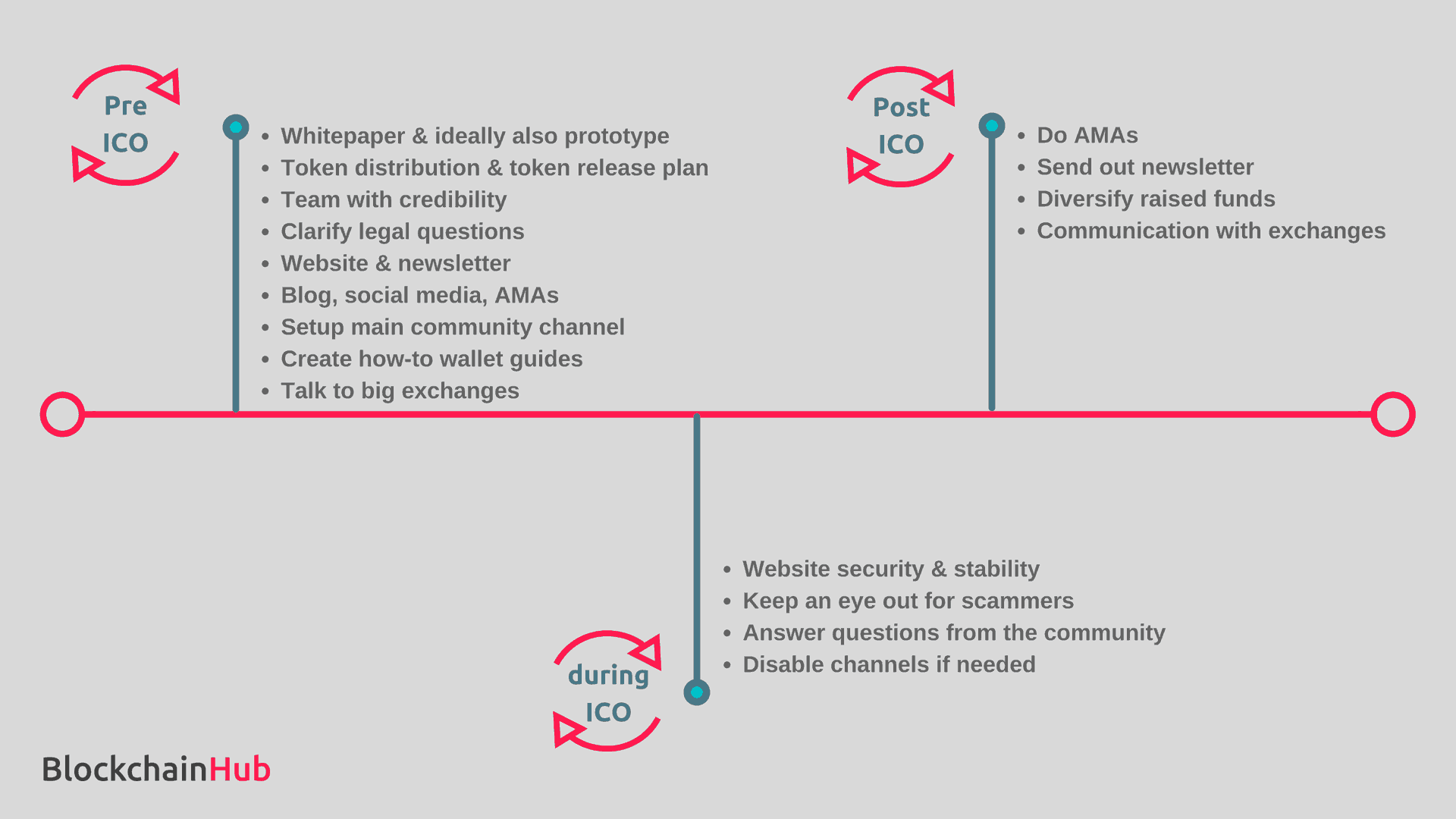
Pre-ICO Development Period
- Presenting an ICO to the public.The company announces its project to the community, and specifies its idea and intentions. The main goal is to draw people’s attention to the campaign.
- Writing a white paper.White-paper development is mandatory for any ICO. It is essential to outline a business plan; present product vision, team members, and technical aspects; and illustrate a detailed roadmap with timelines, showing the funds as well as the token division.
- Complying with legal requirements.To provide investors with safety and make sure the campaign will run in the right manner, all legal questions should be settled during ICO development.
- Attracting ICO advisors.It is important to get professionals on board from different business fields. They will contribute their experience and guide the team through the whole process, helping to resolve problems and working out the best plan to achieve the final goal.
- Creating a token.Token development and implementation are necessary within a blockchain project. The token must be functional and useful. The company has to decide how many tokens they are about to issue, how many will be sold to the public, and how many will be left for future development. The price and value of the token should be evaluated, as well.
- Advertising the campaign.Here, it is essential to find the target audience and present them with the project (offer a unique proposition). The company should perform social media and community management by implementing multi-channel ICO marketing to keep in touch with potential investors and clients. Website and blog creation is another integral part of keeping the community updated.
ICO Period
After settling all of the steps mentioned above, the project is ready to be launched. Holding an ICO means starting the crowdfunding process. Supporters now can invest their funds into the project (with acceptable cryptocurrencies) in exchange for project tokens. During an ICO, it is important to keep an eye on security and make sure that the website is stable and safe to avoid scammers’ attacks.
Post-ICO Development Period
When the project collects sufficient funds according to the goals set in the white paper, the following steps are performed:
- Using the tokens.In this phase of post-ICO development, investors can either save their tokens for the future (in order to sell or trade them on exchange later) or use them within the project (if this is expedient).
- Developing the product.This period consists of numerous actions to push along the product; run the tryouts; improve security within blockchain technology; continue promoting post-ICO public relations; and conduct ICO marketing. It also includes social-media management to keep investors informed about the relevant situation.
Often, when reaching the soft cap, developers stop being active in certain areas, as they think the crowdfunding period is over. This can result in negative outcomes, as post-ICO management is just as important as the previous stages. Let’s have a look at the post-ICO review in detail to understand its necessity.
Post-ICO review: Key Steps to Follow
The post-ICO development period is the terminal part of conducting the campaign. Its main goal is to deliver value and the final product to the customers (token-holders). In the end, company tokens aim to be listed on exchanges, so investors can easily take part in a token sale or exchange, process payments or deposits, and, of course, get their profit.
It is important not to underestimate the necessity of intelligently performing post-ICO strategy. Otherwise, even after crowdfunding, a company can lose money or clients, or receive negative feedback.
During the post-ICO, it is essential to follow the roadmap milestones step by step, with an explanation for each.
Let’s take a look at the main post-ICO development goals.
Post-ICO Public Relations and Marketing Strategy
Post-ICO public relations between the team and investors is one of the priorities both in pre- and post-ICOs. All investors should continue receiving newsletters highlighting current news and updates. Social-media management is an integral part, as well. To communicate with investors and establish favorable public relations, it is highly beneficial to use such channels as Slack, Twitter, or Telegram. Post-ICO marketing strategy also includes working with the website’s blog. This should contain all sorts of information, starting with the latest updates and going further with informative articles about relevant issues. Lately, it has become popular to do AMAs (ask me anything). This helps investors deal with any questions they may come up with.
Post-ICO marketing information on the campaign should be provided on popular Bitcoin blogs, too. This way, it will be available to a larger number of people. It is never too late to expand your audience! According to a number of followers, the best Bitcoin blogs are:

Post-ICO Management and Product Development
When an ICO has been concluded successfully, the funds are collected as expected. It is time to use them for further product development, as stated in the company’s white paper. At the next stage, it is necessary to run product tryouts and make improvements where needed. Every company has an individual roadmap within their ICO development plan, and all milestones should be followed, providing explanations and information on progress to the community.
For a better understanding, let’s consider the example of the Monetha ICO. Their roadmap looks like this:

As of today, there are 42 episodes on Monetha’s website that show their weekly ICO review progress according to the roadmap. They have already developed a new product website and opened access to Monetha’s mobile application. The first product version has been offered to exclusive token-holders. At the moment, they are working on product release to the public (June 2018). It is evident that the company is socially active, and cares enough to inform their clients about the latest news. This benefits the development of their post-ICO public relations.
Raised Funds Distribution
Smart funds distribution determines future project progress. Funds should be held under the proper control and distributed over time according to the holders’ approval. There are several schemes of funds distribution. They are usually used for ICO development and operations, ICO marketing outreach, legal issues, technical compliance, etc. This depends upon the company’s needs and current situation.
Tezosis one of the most successful ICOs of all time. It managed to raise $232 million with +1,138% return in USD. Its funds distribution scheme is as follows:

Another large ICO,Bancor,raised $153 million, with returns of 108% in USD. They divided their costs in the following way:

As seen above, the major amount is allocated for software and engineering development campaigns, while marketing holds third place. Other expenses can vary according to company needs.
Security
Another key point to focus on in post-ICO strategy is the provision of security. With big amounts of collected money, ICOs are always targets for hackers’ attacks. The main risks are considered to be:
- underestimating the importance of security
- system bugs and vulnerabilities in coding
It is important to understand that things may not go as smoothly as planned. Attacks do happen. Therefore, the goal of an ICO is to do its best in order to prevent them. Prior due diligence and planning will help to avoid possible risks. A company should have a crisis plan in place in case anything goes wrong. To avoid double-spending, developers should use a consensus protocol that secures their investors’ trust. Preventative measures should be also taken against DDoS attacks and website replication. In addition, smart contracts should be paid much attention; they must be secure, with resilient codes. Program tests should be performed in advance to spot any vulnerabilities.
Consider complying with programming guides to eliminate possible security pitfalls. Don’t underestimate your community; listening to their thoughts and advice about security concerns should be taken seriously. Monitor all activities within your ICO, and be ready to act fast.
Applicature is a blockchain agency that helps ICOs launch their projects in a highly secure, well-executed manner. The Applicature team can help you with questions about (or assistance with)smart-contract development, implementation of a project within blockchain, and security. Don’t hesitate to contact our professional team.
Trends for Getting a Post-ICO coin Listed on Exchanges
Post-ICO success depends upon how quickly company tokens can be listed on exchanges. As soon as the post-ICO coin is listed, it is available to clients for selling, trading, or exchange purposes. There are certain pitfalls ICO projects can face, at this stage. Tokens can fall in price when listed, due to certain exchange payments. Therefore, companies tend to increase the token value in order to provide their customers with a potential exit.
As of today, there exists a large number of different exchanges. The number of tokens, however is far bigger. It is practically impossible for exchanges to keep up with new, upcoming ICOs and all the tokens they offer. That is why, in order to avoid overwhelm, exchanges are selective about the tokens they list.
As there are no specific criteria for how to choose tokens, exchanges listen to the community. The more people use a specific token, the better it is thought to be.
How to Get Listed on Major Exchanges?
To get listed on major exchanges, the project needs to:
- prove its uniqueness
- be innovative
- provide tokens that do not resemble to securities (in most cases)
- provide tokens that have real demand
- prove that the company’s tokens are not meant for illegal activities
Some exchanges have a simpler process of listing, like Poloniex, for example. There is no payment for listing, but developers must have verified accounts on the website.
Bittrex, another popular exchange, charges some fees. The listing process here is a bit more complex, but if a token meets all requirements, there shouldn’t be any problem.
To list a token on Bittrex, it is necessary to:
- provide a token name
- have a verified account
- provide coin description
- provide a 3-5-letter coin trading symbol
- have a coin logo in png format
- state the launch date
- provide a GitHub link for further due diligence
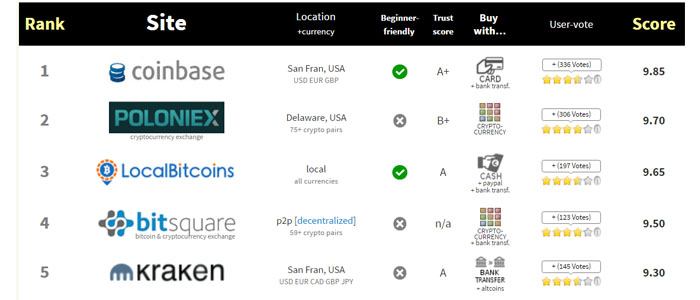
According to CoinDL, the top five cryptocurrency exchanges are outlined as follows:
In conclusion, it is important to stress that post-ICO activity is just as important as pre-ICO and ICO events. It is crucial not to relax after crowdfunding. Long-term success depends upon the effort expended working with software, security, smart contracts, social communication, and marketing strategy. The project must be evaluated both before and after the campaign. This will help eliminate possible obstacles and risks. Transparency is another determinant of prosperity. The more open you are, the more you’re trusted. With that said, here is the last tip for ICOs: don’t overestimate your abilities. There is no need to make too much hype around the project in the pre-ICO. It should meet all the goals in the post-ICO period, proving its quality and reliability.
If you need guidance on your project, please contact our Applicature team!
Need help with a blockchain project?
Applicature has been building blockchain solutions since 2017. Talk to our experts.
Get a Free Consultation